
Desserts
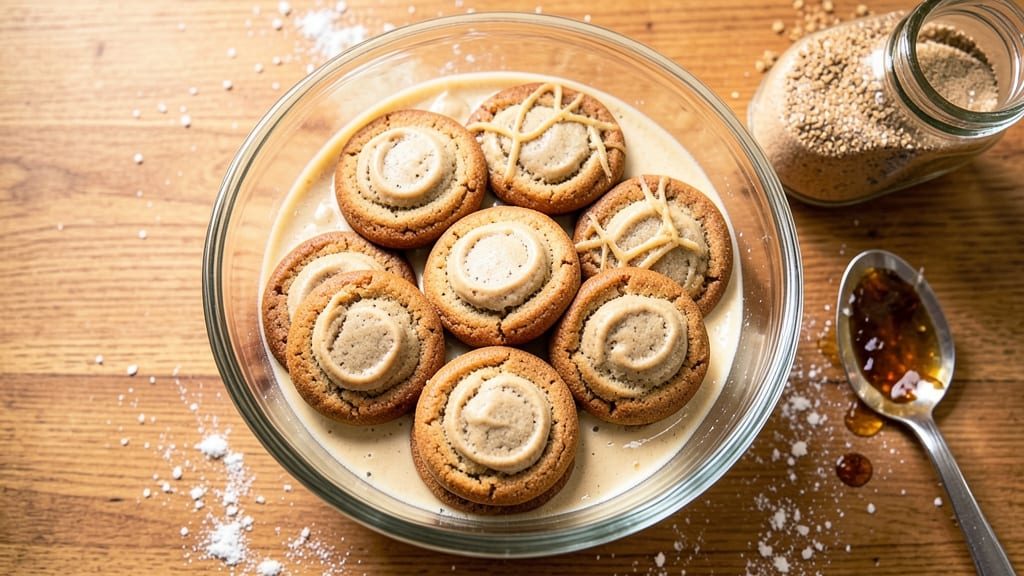
This vegan no-butter cookie recipe delivers the same satisfying crunch and chewy centers without a single stick of butter—just aquafaba swirls for that signature texture. I developed this after years of baking vegan desserts, and it's become my go-to for cookies that impress even non-vegans. The secret lies in the aquafaba (chickpea brine), which creates a light, airy structure while keeping the cookies tender and crispy in all the right places.
The recipe uses simple pantry staples like coconut oil and aquafaba instead of butter, yet achieves that classic cookie texture we all love. You'll find no complicated techniques—just a straightforward mixing process, followed by shaping and baking.
The aquafaba swirls add a subtle, slightly sweet flavor that complements any cookie variation, from classic chocolate chip to oatmeal raisin.
What you'll end up with is a batch of cookies that's crispy at the edges, chewy in the middle, and perfectly pillowy—all without butter. The aquafaba gives them a delicate crunch that disappears with each bite, leaving behind a satisfying texture.
These cookies are perfect for sharing, gifting, or enjoying with a glass of milk (or plant-based alternative).
Once baked, let them cool for 10 minutes before transferring to a wire rack. They'll stay fresh for up to 5 days in an airtight container, or you can freeze them for up to 3 months.
The beauty of this recipe is its adaptability—swap in your favorite mix-ins or keep it simple with classic flavors. Let's get baking!
Ingredients for vegan cookie recipe no butter
Simple pantry staples transform into vegan cookies with crispy edges and chewy centers—no butter needed.
| Ingredient | Amount | Notes |
|---|---|---|
| Aquafaba 🥫 | ½ cup | Chickpea brine, unsweetened |
| Coconut Oil 🥥 | ½ cup | Solid, not melted |
| Granulated Sugar 🍚 | ¾ cup | Organic preferred |
| Brown Sugar 🍯 | ½ cup | Packed firmly |
| Vanilla Extract 🌿 | 1 tbsp | Pure vanilla preferred |
| All-Purpose Flour 🌾 | 1 ½ cups | Unbleached, sifted |
| Baking Soda 🧂 | ½ tsp | Freshly opened |
| Salt 🧂 | ½ tsp | Fine sea salt |
| Chocolate Chips 🍫 | 1 cup | Vegan chocolate chips |
| Almond Flour 🌰 | ¼ cup | Finely ground |
| Maple Syrup 🍁 | 1 tbsp | For aquafaba swirls |
The aquafaba is the star here—save the brine from a can of chickpeas (or buy it pre-packaged at stores like Whole Foods). It mimics egg whites perfectly, creating that signature cookie crunch. For the coconut oil, grab the solid kind (not melted)—it adds richness without butter. The sugars? Brown sugar keeps them chewy, while white sugar adds crispiness. I always double-check my vanilla extract is pure—imitation stuff ruins the flavor. Flour matters too: King Arthur or Bob's Red Mill brands stay fresh longer.
No aquafaba? Flax eggs (1 tbsp ground flaxseed + 3 tbsp water = 1 egg) work in a pinch, but texture won't be identical. Swap chocolate chips for vegan caramel bits or dried fruit—just adjust baking time if using softer mix-ins. The almond flour adds depth (and protein), but oat flour works too if you're out. For the swirls, maple syrup is key—agave or date syrup are good backups. Pro tip: Toast your almond flour for 5 minutes to deepen the flavor (trust me on this).
Store baked cookies in an airtight container with parchment paper between layers—they stay fresh for 5 days. Freeze dough balls for 3 months—bake straight from frozen, adding 2-3 minutes. The aquafaba swirls keep best if you bake immediately, but prepped dough holds for 24 hours in the fridge. These cookies reheat beautifully—just 10 seconds in the microwave to revive that fresh-baked crunch.
Why You'll Love This Recipe
- No Fuss Mixing: I swear by the aquafaba trick—just whisk it like egg whites, and boom, you’ve got that perfect chew. No butter, no stress, just a bowl and a hand mixer doing all the work while you chat with someone (or scroll mindlessly).
- Caramelized Crunch: That combo of coconut oil and brown sugar? It’s the secret to cookies with a crispy edge and a soft center—like a hug for your taste buds. The vanilla ties it all together without overpowering, which, honestly, is a miracle in cookie land.
- Party-Ready Flex: These bake up fast, so I can make a batch for potlucks or last-minute gifts. They freeze like a dream too—just toss them in a bag, and you’ve got dessert covered for weeks. (Yes, even on a Tuesday night.)
- Pantry Magic: I’m always stocked with coconut oil and sugar, so this recipe never feels like a special occasion. A can of chickpeas (for the aquafaba) and vanilla extract are basically staples at this point—minimal cost, maximum satisfaction.
Step-by-step instructions for vegan no-butter cookie recipe
Here's how to create these magical vegan cookies with a perfect aquafaba swirl every time.
Whip the Aquafaba to Stiff Peaks
Start by measuring out the 0.5 cup aquafaba into a clean, grease-free mixing bowl. I like to use a stand mixer fitted with the whisk attachment for this step—it creates the most stable peaks. Whip the aquafaba on high speed for 5-7 minutes until it forms stiff, glossy peaks that hold their shape when you lift the whisk.
You'll know it's ready when you can turn the bowl upside down and the aquafaba doesn't slide out. This step is crucial because the aquafaba acts as our egg substitute, providing both structure and that signature swirl. If you don't have a stand mixer, use a hand mixer—but be prepared to work it for a few extra minutes to reach the same consistency.
Cream the Coconut Oil and Sugars
In a separate large mixing bowl, combine the 0.5 cup solid coconut oil (make sure it's not melted—it should be soft but still hold its shape) with the 0.75 cup granulated sugar and 0.5 cup packed brown sugar. Using the paddle attachment on your mixer, beat everything together on medium speed for 3-4 minutes until the mixture is light, fluffy, and nearly doubled in volume.
This creaming process incorporates air, which helps create that classic cookie texture. You'll see the mixture go from a solid block to a pale, almost frothy consistency. If your coconut oil is too soft or melty, chill it in the fridge for 15-20 minutes before starting—this ensures proper structure in your cookies.
Combine Wet Ingredients and Fold in Dry Components
Add the 1 tbsp vanilla extract and 1 tbsp maple syrup to your creamed mixture and mix on low speed for 30 seconds until fully combined. In a separate bowl, whisk together the 1.5 cups all-purpose flour, 0.25 cup almond flour, 0.5 tsp baking soda, and 0.5 tsp salt.
With the mixer on low speed, gradually add the dry ingredients to the wet mixture, mixing just until combined. Be careful not to overmix—you should still see some flour streaks. Once combined, fold in the 1 cup chocolate chips using a spatula, making sure they're evenly distributed throughout the dough. The dough will be thick and sticky, but that's exactly what we want for these cookies.
Create the Aquafaba Swirls and Chill
Using a spoon or small spatula, gently fold about 2 tablespoons of the whipped aquafaba into the dough to create swirls. Don't overwork it—just create gentle, marbled patterns throughout. Transfer the dough to a bowl, cover with plastic wrap, and refrigerate for at least 1 hour (or up to 24 hours for even better flavor).
This chilling step is essential—it allows the coconut oil to firm up slightly, which prevents excessive spreading in the oven. It also gives the flavors time to meld together. While the dough chills, preheat your oven to 350°F and line two baking sheets with parchment paper. The dough will be quite thick, so you'll want to work quickly when you're ready to bake.
Bake to Golden Perfection
Using a cookie scoop or tablespoon, portion the chilled dough into 1.5-tablespoon sized balls (about 20-22 cookies total) and place them 2 inches apart on the prepared baking sheets. Bake for 12-14 minutes until the edges are golden brown and the centers still look slightly soft.
The cookies will continue to set as they cool, so don't overbake them. They should be soft and pillowy in the center with just a hint of crunch at the edges. Let them cool on the baking sheets for 5 minutes before transferring to a wire rack to cool completely. The aquafaba swirls will be visible through the chocolate chips, giving you that beautiful marbled effect that makes these cookies special.
Pro Tips For Making Vegan Cookie Recipe No Butter
- WHISK AQUAFABA COLD: I learned this the hard way—warm aquafaba loses volume faster. Whisk it straight from the can, no heating needed, and you’ll get that fluffy meringue texture without the flat disappointment.
- MELT COCONUT OIL SLOW: Skip the microwave. Warm the coconut oil in a bowl over simmering water (double boiler) until just liquid—about 2 minutes. Too hot, and it’ll turn greasy; too cool, and your cookies stay dense.
- CHILL DOUGH LONGER: This isn’t the prettiest method, but it’s the tastiest. Refrigerate the dough for at least 2 hours (overnight is better). The coconut oil firms up, preventing flat cookies and making them chewier.
- WEIGH YOUR SUGARS: Brown sugar clumps like a drama queen. Use a kitchen scale for precise measurements—1 cup packed vs. 1 cup loosely packed makes a real difference in moisture and spread. No scale? Spoon it in and level with a knife.
Essential equipment for perfect results
Mixing Essentials
Your stand mixer is the MVP here—no butter means we need it to handle the aquafaba whipping and creaming. I swear by the KitchenAid Artisan Series with the whisk and paddle attachments—it handles both tasks flawlessly.
For aquafaba, the whisk attachment creates those perfect stiff peaks that mimic egg whites. The paddle attachment then transforms coconut oil and sugar into a light, airy base.
If you're budget-conscious, a Cuisinart SM-50BC hand mixer works too, but be ready to work the aquafaba for an extra 2-3 minutes. 🔥
Baking Tools
Parchment paper is non-negotiable—it prevents sticking and makes cleanup a breeze. I use Reynolds Non-Stick Parchment Paper because it handles the high heat of 350°F without curling. A cookie scoop (like the OXO Good Grips 1.5-tablespoon size) ensures consistent dough balls, which means even baking.
For portioning, I also keep a wet spatula nearby to handle sticky dough without tearing. Don't skip the wire rack—it's crucial for even cooling and preventing soggy bottoms.
Temperature Control
An oven thermometer is your best friend—home ovens can vary by 25°F or more. I use the Thermoworks Oven Thermometer to confirm my oven hits 350°F accurately. For the aquafaba swirls to set properly, we need that precise temperature.
If your oven runs hot, reduce to 340°F to prevent over-browning. Pro tip: Place your baking sheets on the middle rack—this ensures even heat distribution for perfectly golden edges. ⚡
Storage Containers
Air-tight containers are key for keeping these cookies fresh. I love Glasslock 32-ounce containers because they stack neatly in the pantry and let me see the cookies inside.
For freezing dough balls, I use quart-sized freezer bags—they lay flat, saving space, and I squeeze out all the air to prevent freezer burn. Label everything with the date (they're best within 3 months). A parchment-lined container works too, but glass is my go-to for daily storage.
Optional Extras
Want to take these to the next level? A piping bag with a star tip (like the Ateco 1M) lets you pipe decorative swirls on top before baking. For extra crunch, toast 1 tbsp sliced almonds in a dry pan for 2 minutes before pressing them into warm cookies.
I also keep a small offset spatula handy for spreading any extra aquafaba swirls on top before the final bake—it adds that restaurant-quality finish. 💫
Nutrition facts
Frequently asked questions
Can I substitute aquafaba with something else?
Yes! If you don't have aquafaba, flax eggs (1 tbsp ground flaxseed + 3 tbsp water = 1 egg) work in a pinch, though texture will be slightly denser. For a closer match, try silken tofu blended smooth (¼ cup replaces ½ cup aquafaba), but expect a more cake-like result. The aquafaba swirls are what create that signature crispy crunch—without it, you'll lose that unique texture.
Why do my cookies spread too much?
Over-creaming the coconut oil or skipping the 1-hour chill are the top culprits. Make sure your coconut oil is solid but soft (not melted), and chill the dough thoroughly. If your oven runs hot, reduce temperature to 340°F and bake 1-2 minutes longer. For extra structure, add 1 tbsp cornstarch to the dry ingredients.
What's the best way to store these cookies?
Keep them fresh for 5 days in an airtight container with parchment paper between layers. For longer storage, freeze dough balls (up to 3 months)—bake straight from frozen, adding 2-3 minutes. If storing baked cookies, place them in a cool, dark place (like a pantry) rather than the fridge to prevent moisture buildup.
Can I make these gluten-free?
Replace the all-purpose flour with a 1:1 gluten-free baking flour blend (like Bob's Red Mill) and use certified gluten-free oats if adding oats. The almond flour can stay—it's naturally gluten-free. Note that texture may be slightly crumbly, so add 1 tbsp xanthan gum if your blend doesn't include it.
How do I get the aquafaba swirls to show?
Gently fold the aquafaba into the dough in 3 stages—first mix 1 tbsp into the center, then fold the dough over it, then repeat. For extra visibility, press a spoonful of aquafaba onto the top of each cookie before baking. The swirls will set as they bake, creating beautiful marbling. If they disappear, your dough may be too warm—chill it longer.